By Diana Pullen | Listing Specialist, Real Broker LLC | Serving Redmond, Bend, Terrebonne, Culver, Sisters, Prineville, Madras, La Pine, and surrounding communities
My parents have lived in their home for decades. My mom is deep into what she calls Swedish death cleaning; intentionally sorting through her belongings while she still can, so her kids don’t have to do it later. She gets it. She’s making decisions about her things with clear eyes and a generous heart.
My dad has shelves of college calculus books he hasn’t opened in 50 years.
If you’ve been in your home for 20-plus years, you probably know exactly which one of them you are. And if you’re thinking about selling, the stuff is often the thing standing between you and actually getting there.
Here’s how to approach it without losing your mind.
Why This Matters More Than Most Sellers Realize
Buyers need to be able to see your home. Not your life in it. That sounds a little cold but it’s actually important: when a buyer walks through a home that’s still fully lived in, fully decorated, and fully occupied by 20 years of accumulated belonging, it’s very hard for them to imagine themselves there. The house doesn’t feel available. It feels occupied.
Empty-ish rooms feel larger. Cleared surfaces photograph better. Closets with breathing room signal storage rather than overflow. Every item you remove before listing makes your home easier for a buyer to picture as theirs.
This is not about erasing your life. It’s about creating space for the next chapter; theirs and yours.
The Swedish Death Cleaning Approach
The concept is simple even if the name is a little jarring: go through your things now, while you have the energy and the clarity to decide what matters, rather than leaving that work to the people who love you. It’s an act of generosity as much as practicality.
You don’t have to do it all at once. You don’t have to be ruthless. You just have to start.
The question to ask about each item is not “do I love this?” because you probably love a lot of things that you haven’t looked at in a decade. The more useful question is “does someone in my life want this, and if not, is it worth the space it’s taking up?”
A Sequence That Actually Works
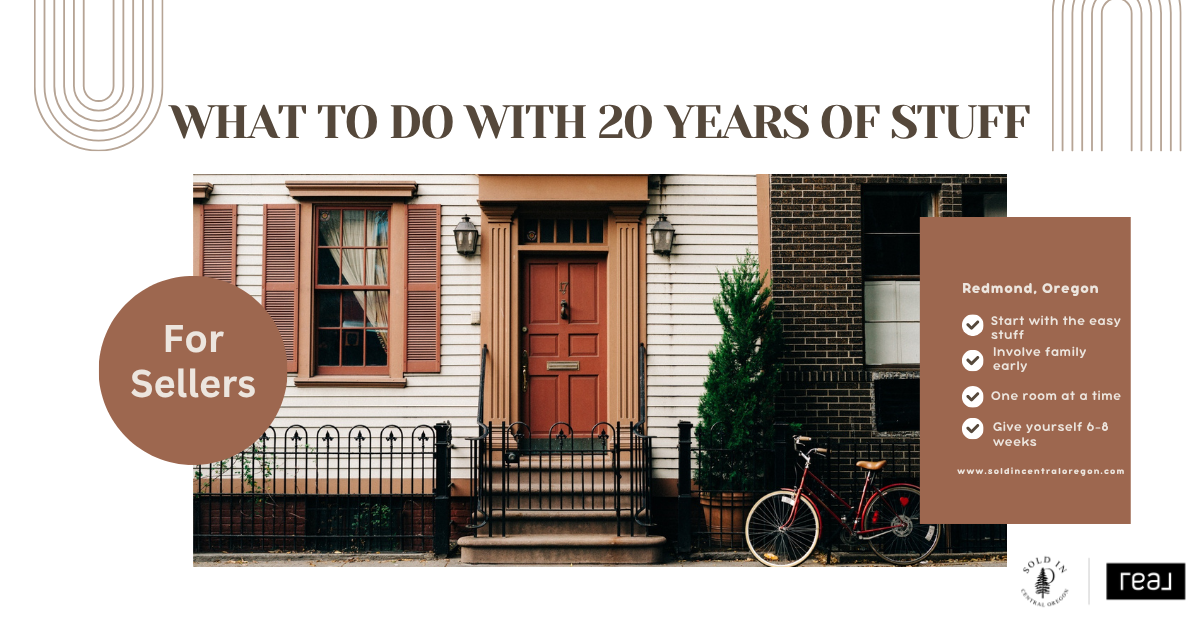
Start with the things that have no story. Duplicates, expired things, items from a previous house that never quite found a home in this one, things you kept meaning to deal with. These go first. No decisions required, just removal. Getting volume out of the house early creates momentum and makes the harder decisions easier.
Involve family before you start donating. Before anything leaves the house, give the people who might want it a chance to say so. One email or text to your kids and grandkids with a list of what’s available; furniture, collections, items with family history; takes 20 minutes and saves a lot of “I wish I’d asked about that” later. Give them a deadline. What’s unclaimed by then goes.
Tackle one room at a time, not the whole house. Trying to do everything at once leads to piles in hallways and a general sense of chaos that makes the project feel impossible. One room, fully sorted and cleared, feels like progress. Progress keeps you going.
Rent a storage unit if needed. If you can’t get things out of the house quickly but you can get them out of sight, that’s a reasonable intermediate step. Buyers don’t see storage units. They do see crowded garages and overfull spare rooms.
Accept that some things will go to strangers. Estate sales, Facebook Marketplace, donation centers, and the dumpster are all legitimate destinations. The goal is not to find a perfect home for every object. The goal is to free yourself to move on. Most things can be replaced by the person who ends up wanting them. The ones that can’t are the ones worth keeping.
The Calculus Books Problem
I say this with love for my dad: there are things people hold onto not because they’ll ever use them or even look at them again, but because letting go of them means something they’re not quite ready to feel.
College calculus books from 50 years ago are not really about calculus. They’re about a version of yourself that existed then, and the idea that throwing them out means that version is really gone. That’s a real feeling and it deserves to be treated gently.
But here’s the other truth: keeping everything doesn’t preserve the past. It just makes the present harder to move through. At some point the kindest thing, for yourself and for the people who love you, is to hold onto what genuinely matters and let the rest go.
If you have someone in your life who is holding onto things in this way and you’re not sure how to help them through it, patience is usually the answer more than persuasion. People get there when they get there. The most useful thing you can do is make the practical path as easy as possible; bring the boxes, make the donation run, be present for the part that’s hard without making it harder.
What Your Home Needs to Look Like Before It Lists
Once the sorting is done, here’s what you’re aiming for before professional photos are scheduled:
Every surface cleared to the essentials. Closets edited to about 50 to 60% full so they read as spacious. Furniture reduced to what makes the room function well; extra pieces in storage or gone. Personal photos and highly specific decor minimized so the home feels welcoming to a range of buyers rather than specific to one family’s taste.
This is not staging in the traditional sense. It’s just creating the version of your home that lets buyers see it clearly rather than through the lens of your life in it.
Give Yourself More Time Than You Think You Need
Six to eight weeks is the minimum for most long-term homeowners. Three to four months is better if your target list date is flexible. The sellers who feel the most prepared and the least stressed are almost always the ones who started this process earlier than felt necessary.
If you’re thinking about selling in the next six months, now is not too early to start. In fact, it’s just about right.
Diana Pullen, listing specialist in Redmond and Central Oregon, Real Broker LLC. If you want to talk through what your timeline could realistically look like and what your home is worth right now, I’m happy to start that conversation.
https://www.calendly.com/diana-soldincentraloregon/consult
This post is for informational purposes only.