How to Sell Your Home in Central Oregon in 2026 A Seller’s Guide
By Diana Pullen | Listing Specialist, Real Broker LLC | Serving Redmond, Bend, Terrebonne, Sisters, Prineville, Culver, Madras, La Pine, and surrounding communities
If you’re thinking about selling your home in Central Oregon — whether you’re in Redmond, Bend, Terrebonne, Sisters, Prineville, Culver, Madras, or La Pine — this guide is for you.
The 2026 market is not the frenzied seller’s market of 2021, and it’s not a buyer’s market either. It’s a market where preparation and pricing strategy separate the homes that sell in the first two weeks from the ones that sit and accumulate days on market. Every community in Central Oregon operates differently — what works in Bend won’t necessarily work in Madras, and a Prineville pricing strategy won’t translate to Sisters.
This guide covers what’s actually happening across Central Oregon right now, what you need to do before you list, how to price correctly, and what to expect during the process. No hype. Just the information you need to make a smart decision.
The Central Oregon Market in 2026: What Sellers Need to Know
Central Oregon has transitioned into a more balanced market after several years of extreme inventory shortage. Demand remains strong across the region — driven by in-migration from California, Texas, and other high-cost states — but buyers in 2026 are more selective. They compare homes online before requesting a showing, they’re sensitive to price, and they have more options than they did two years ago. Overpriced and under-prepared homes now sit.
Here’s how each market in the region is behaving right now:
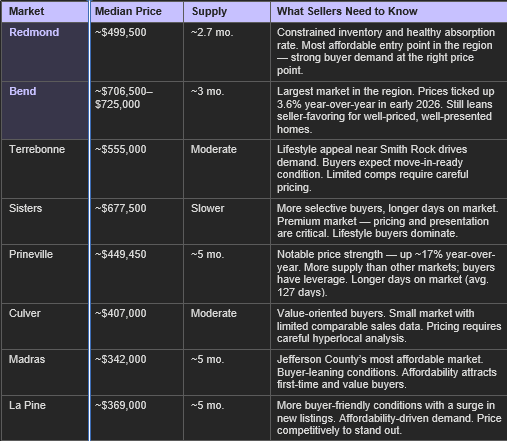
Source: MLS of Central Oregon, Deschutes County market reports, and regional data as of early 2026. Prices are approximate medians. Verify current figures with your listing agent before pricing.
The most important thing this table shows
No two Central Oregon markets behave the same. Redmond and Bend have the healthiest absorption rates and strongest buyer demand. Prineville, Madras, and La Pine have more supply, giving buyers more leverage. Sisters commands a premium but requires patience. Your pricing strategy must be built for your specific market — not for "Central Oregon" as a whole.
A Closer Look: Selling in Redmond and Bend
Redmond and Bend are the two primary markets in Central Oregon, and they behave differently from each other and from the surrounding communities. If you’re selling in either market, here’s what you need to know.
Selling in Redmond
Redmond is the most affordable market in the region, and that affordability is a feature — not a limitation. It attracts a steady pool of buyers who have been priced out of Bend: first-time buyers, growing families, and relocators who want Central Oregon’s lifestyle without Bend’s price tag.
With an absorption rate of roughly 2.7 months, Redmond’s inventory is tighter than most surrounding markets. A well-priced, well-prepared home in Redmond can still generate strong activity in the first two weeks. But Redmond buyers are price-sensitive. Homes that stretch above the realistic comp range sit. New construction in Redmond also competes directly with resale — buyers weighing a new build against your home are comparing warranties, finishes, and price per square foot in detail.
What this means for Redmond sellers: Price to the comps, not above them. Focus on condition and presentation — Redmond buyers in this price range have seen a lot of inventory and they know the difference between a well-maintained home and one that’s been deferred. Don’t overprice expecting to negotiate down; Redmond buyers skip overpriced homes rather than making lower offers.
Selling in Bend
Bend is Central Oregon’s largest and most visible market, with a median price that climbed to roughly $706,500–$725,000 in early 2026 — a 3.6% year-over-year increase. Inventory sits near three months of supply, which still leans seller-favoring for homes that are accurately priced and well-presented.
The Bend buyer pool is more diverse than any other market in the region: local move-up buyers, out-of-state relocators, remote workers, retirees, and investors all compete for the same inventory. That diversity can work in your favor — but it also means buyers have done their research. They know what comparable homes sold for. They’ve watched listings sit after price reductions. They’re patient.
New listings increased in early 2026 as the spring market opened, which means more competition for your home. Well-positioned listings — priced correctly, photographed professionally, and presented at their best — are still moving efficiently. Overpriced listings are accumulating days on market.
What this means for Bend sellers: Bend rewards preparation and precision. The gap between a home that sells in 15 days and one that sits for 90 is almost always pricing and presentation — not location. Get a rigorous comparable sales analysis before you list, and invest in professional photography and pre-listing preparation.
Why Redmond and Bend sellers need different strategies
Redmond sellers are competing with new construction at the lower price tier and need to win on value and condition. Bend sellers are competing in a larger, more sophisticated market where buyers have more options and more information. The same listing approach doesn’t work in both markets — and an agent who treats them the same is not serving you well.
Step 1: Decide If Now Is the Right Time to Sell
The best time to sell is when your personal circumstances align with a market that gives you a realistic shot at your goals. Here’s how to think through the timing question across Central Oregon.
Factors that favor selling now (spring–summer 2026)
• Buyer activity peaks April through July across Central Oregon — more showings, more competition among buyers
• Inventory is rising but not yet oversupplied in the primary markets — Redmond and Bend still lean toward sellers for well-priced homes
• Projected interest rate decreases in 2026 may bring buyers who have been waiting off the sidelines
• If you’re moving within the region, buying and selling in the same market environment generally balances out
Factors that suggest waiting or adjusting your approach
• Your home needs significant deferred maintenance — selling as-is in today’s selective market means a steeper discount than it would have in 2021
• You’re in a higher-supply market (Prineville, Madras, La Pine) and your home isn’t differentiated — more supply means more competition
• You’re not financially or logistically ready to move — rushing a sale to hit a market window rarely produces the best result
Bottom line: there’s no universally right time to sell. There’s only the right time for your situation, in your market, with the right preparation and price.
Step 2: Prepare Your Home Before It Hits the Market
The first 10 days on market are the most critical window for any listing. Buyers are active. Agents are watching. Showing activity and early feedback tell the market whether your home is correctly priced and well-presented — or whether it’s going to sit.
Preparation is how you manufacture a strong first 10 days. This applies in every Central Oregon market, from Bend to La Pine.
What actually moves the needle
• Deep clean and declutter — closets, garage, outdoor spaces, and every surface buyers will see
• Fresh interior paint in neutral tones — one of the highest-ROI improvements you can make before listing
• Landscaping and curb appeal — buyers form their first impression before they walk through the door
• Deferred maintenance repairs — buyers in 2026 flag issues, request credits, or walk away; address them before the inspection
• Professional photography — over 90% of buyers search online first; your photos are your first showing
• Pre-listing inspection (optional but valuable) — knowing your home’s condition lets you price accurately and disclose confidently
What doesn’t move the needle
Over-improving. A $40,000 kitchen renovation in Madras or Culver will not return $40,000 at the closing table. In Bend’s upper price tiers, high-end finishes matter more — but even there, condition and presentation beat renovation in most cases. Focus your energy on clean, functional, and well-maintained.
Step 3: Price Your Home Correctly the First Time
Pricing is the single most consequential decision you’ll make as a seller. Not because it directly determines your final sale price, but because it determines how the market responds in those critical first two weeks.
Homes priced correctly from day one generate showing activity, competitive offers, and faster closings. Homes priced too high get skipped online, receive fewer showings, accumulate days on market, and ultimately sell for less than they would have if priced correctly at the start. This pattern plays out in every Central Oregon market.
How pricing goes wrong
• Using out-of-market comps — a Sisters sale doesn’t inform a Prineville price; a Bend sale doesn’t inform a Redmond price
• Pricing based on what you paid, what you’ve invested, or what you need — the market doesn’t know or care about your basis
• Attributing value to improvements that buyers don’t weigh the same way you do
• “Testing the market” at a high price to see what happens — what happens is days on market accumulate, buyers assume something is wrong, and your negotiating leverage disappears
What correct pricing looks like
A well-priced home is based on recent comparable sales — similar homes in similar locations that have actually closed, not homes currently listed or pending. It accounts for your home’s specific condition, your neighborhood’s dynamics, the current supply level in your market, and what buyers are realistically paying right now.
In Redmond and Bend, where there’s enough comparable sales data to support a precise pricing analysis, this work is straightforward. In smaller markets like Culver, Madras, or Terrebonne, where comp volume is lower, pricing requires more judgment and hyperlocal knowledge — which is exactly where an experienced listing agent earns their value.
A note on market-specific pricing
Redmond’s price-sensitive buyers and competition from new construction require precise positioning at or just below the comp range. Bend’s larger buyer pool allows slightly more flexibility, but overpricing still triggers the same sitting pattern. In Prineville and La Pine, with 5+ months of supply, buyers have options — aggressive pricing is not a strategy; competitive pricing is.
Step 4: Understand the Listing and Selling Process
Here’s a realistic timeline of what to expect once you’re ready to move forward.
Phase
What Happens
2–4 weeks before listing
Home preparation, repairs, staging, and professional photography. Pricing analysis with your agent. Listing agreement signed. Pre-listing inspection if applicable.
Days 1–10 on market
The most critical window. Showing activity and buyer feedback reveal how the market perceives your price and presentation. This window sets the trajectory of your listing.
Offer received
Review price, terms, contingencies, and financing type. In Redmond and Bend, multiple offers are still possible on well-positioned homes. Negotiate from data, not emotion.
Under contract
Buyer inspection period (typically 10 days in Oregon). Buyer may request repairs or credits. Appraisal if buyer is financing. Lender underwriting begins.
Closing
Typically 30–45 days from accepted offer. Oregon is an escrow state — closing is handled through a title company. You sign documents, title transfers, and proceeds are disbursed.
Step 5: Choose the Right Listing Agent
In a market where pricing strategy and preparation are the primary variables that determine your outcome, the listing agent you choose matters more than it did when everything sold regardless.
Here’s what to evaluate, especially if you’re selling in a market like Central Oregon where each community behaves differently:
• Do they know your specific market — Redmond vs. Bend vs. Prineville — or do they treat all of Central Oregon as one market?
• Can they explain their pricing methodology with actual comparable sales data, not intuition or Zestimates?
• What does their marketing actually look like? Professional photography, MLS, online syndication, video content?
• Do they have a verifiable track record of days on market and list-to-sale ratios in your area?
• Are they a listing specialist — someone who focuses on the seller side — or a generalist who splits time equally between buyers and sellers?
Why listing specialists think differently
A listing specialist like Diana Pullen focuses entirely on the seller side of the transaction. That means deeper expertise in pre-listing preparation, pricing strategy, negotiation from the seller’s position, and marketing. It’s not that generalist agents can’t do the job — it’s that someone who lives in the listing process every day develops a different level of precision. When the difference between a well-positioned listing and a poorly positioned one is $15,000–$30,000 at the closing table, that precision matters.
Common Seller Mistakes to Avoid in 2026
• Overpricing and planning to negotiate down — buyers in 2026 skip overpriced homes rather than making lower offers
• Skipping professional photography — in every Central Oregon market from Bend to La Pine, buyers search online first
• Not disclosing known issues — Oregon has specific seller disclosure requirements; undisclosed defects can derail a closing or create post-closing liability
• Accepting the first offer based on price alone — contingencies, financing type, and closing timeline all affect your actual net result
• Making decisions based on emotion rather than data — your home’s market value is what buyers will pay today, not what you paid, what you invested, or what your neighbor told you their house was worth
• Choosing an agent based on the highest suggested list price — an inflated price projection is a sales tactic, not a service
Ready to Talk About Selling Your Home in Central Oregon?
Whether you’re in Redmond, Bend, Terrebonne, Sisters, Prineville, Culver, Madras, or La Pine — the conversation starts with a straightforward look at your home, your specific market, and your goals.
I work exclusively on the listing side. That means my entire focus is on positioning your home correctly, pricing it to generate real activity, and getting you to the closing table with the best possible outcome — without the runaround.
I don’t do high-pressure consultations. I do data-driven ones. You’ll leave with a clear picture of what your home is worth in today’s market, what it would take to position it well, and whether now is the right time for your situation.
Diana Pullen | Listing Specialist
Real Broker LLC | Central Oregon
Serving Redmond • Bend • Terrebonne • Sisters • Prineville • Culver • Madras • La Pine
📞 541.398.5770 • 🌐 soldincentraloregon.com
📅 Schedule your free listing strategy call: calendly.com/dianapullen-realtor/30min
This post is for informational purposes only and does not constitute legal, financial, or tax advice. Market data is approximate, reflects conditions as of early 2026, and is sourced from MLS of Central Oregon, Deschutes County reports, and regional market analyses. Contact Diana Pullen for a current analysis specific to your property and market.